Description
Master internship
The propagation of reaction-diffusion fronts in flow-stirred media is encountered in many areas of nature (forest fires, epidemics, plankton dynamics) or industry (chemical engineering, engines). A noticeable effect is that the average velocity of the front is enhanced by flows, which can be sought-after in industry (increased reactivity) or feared in natural environments (amplified fires or pandemics). In both cases, it is essential to better predict, model and understand the propagation of fronts as a function of the features of the flow to which they are subjected.
The aim of the internship will be to study experimentally the behavior of a reaction-diffusion front in a flow composed of :
- a regular array of time-modulated vortices, or
- a disordered array of vortices.
When vortex amplitude is time-modulated, resonance effects on front propagation are expected for certain periods of flow oscillation. When the vortex network is disordered, we wish to look at the impact of modifications to the ordered network on the propagation of the reaction-diffusion front. The interpretation of the physical situations thus produced can be enriched by kinematic or dynamic models of advection-reaction-diffusion fields at various scales.
The study will use a model experiment to create a variety of controlled flows, and to observe front propagation in situ and in real time. It is based on a redox reaction in solution and on flows produced by electroconvection in a Hele-Shaw cell. The figure below shows the propagation of the reaction-diffusion front in a regular network of time-stationary vortices, a situation studied in previous studies.
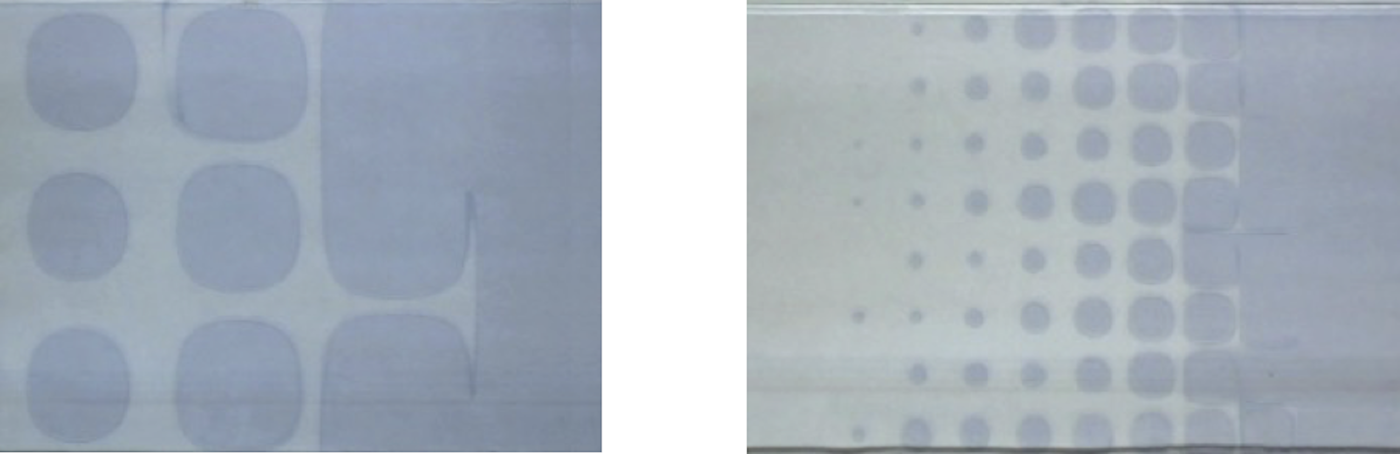
Figure 1 - Front propagating in a network of wide (left) or fine (right) vortices. The fresh medium (before reaction) is blue; the burnt medium (after reaction) is white; the fronts are located at their boundaries. The front moves on average from left to right and, in vortices, from their periphery to their center.
Related publications
- Abraham, E. R., The generation of plankton patchiness by turbulent stirring, Nature, 391, 577 (1998).
- Cencini, M., Torcini, A., Vergni, D. and Vulpiani, A., Thin front propagation in steady and unsteady cellular flows, Phys. Fluids, 15, 679 (2003).
- Vladimirova N., Constantin P., Kiselev A., Ruchayskiy O., and Ryzhik L., Flame enhancement and quenching in fluid flows, Combust. Theory Modelling, 7, 487 (2003).
- A. Pocheau, F.Harambat, Front propagation in a laminar cellular flow : Shapes, velocities, and least time criterion, Phys.Rev.E, 77, 036304 (2008).
- Tzella, A. and Vanneste, J., Fkpp fronts in cellular flows : the large-Péclet regime, SIAM J. Appl. Math., 75, 1789 (2015).
- Beauvier E., Bodea S., Pocheau A., Front propagation in a vortex lattice : dependence on boundary conditions and vortex depth, Soft Matter, 12, 8935 (2016)
- Beauvier E., Bodea S., Pocheau A., Front propagation in a regular vortex lattice: dependence on the vortex structure, Physical Review E, 96, 053109 (2017)
- Bodea S., Beauvier E., Pocheau A.,Front propagation in cellular flows: scale dependence versus scale invariance, J. Fluid Mech., 968, A29 (2023).
Contact
Simona Bodéa : simona.bodea@univ-amu.fr -- 04 13 55 20 57